The transition from laminar flow to turbulence itself is a stability problem; fluid-mechanical instability can trigger the transition of a flow to turbulence. In real life, such as in atmospheric and oceanic turbulence, there do exist situations genuinely close to two-dimensional turbulence, because motion is largely confined to a horizontal plane. Most large-scale geophysical turbulence behaves this way because one direction is strongly constrained, leaving only two horizontal directions where motion can develop. Kelvin–Helmholtz instability represents this kind of situation.
It should be noted that if you have a two-dimensional structure, there will inevitably be a secondary instability, so there must be structure developing in the other perpendicular direction.
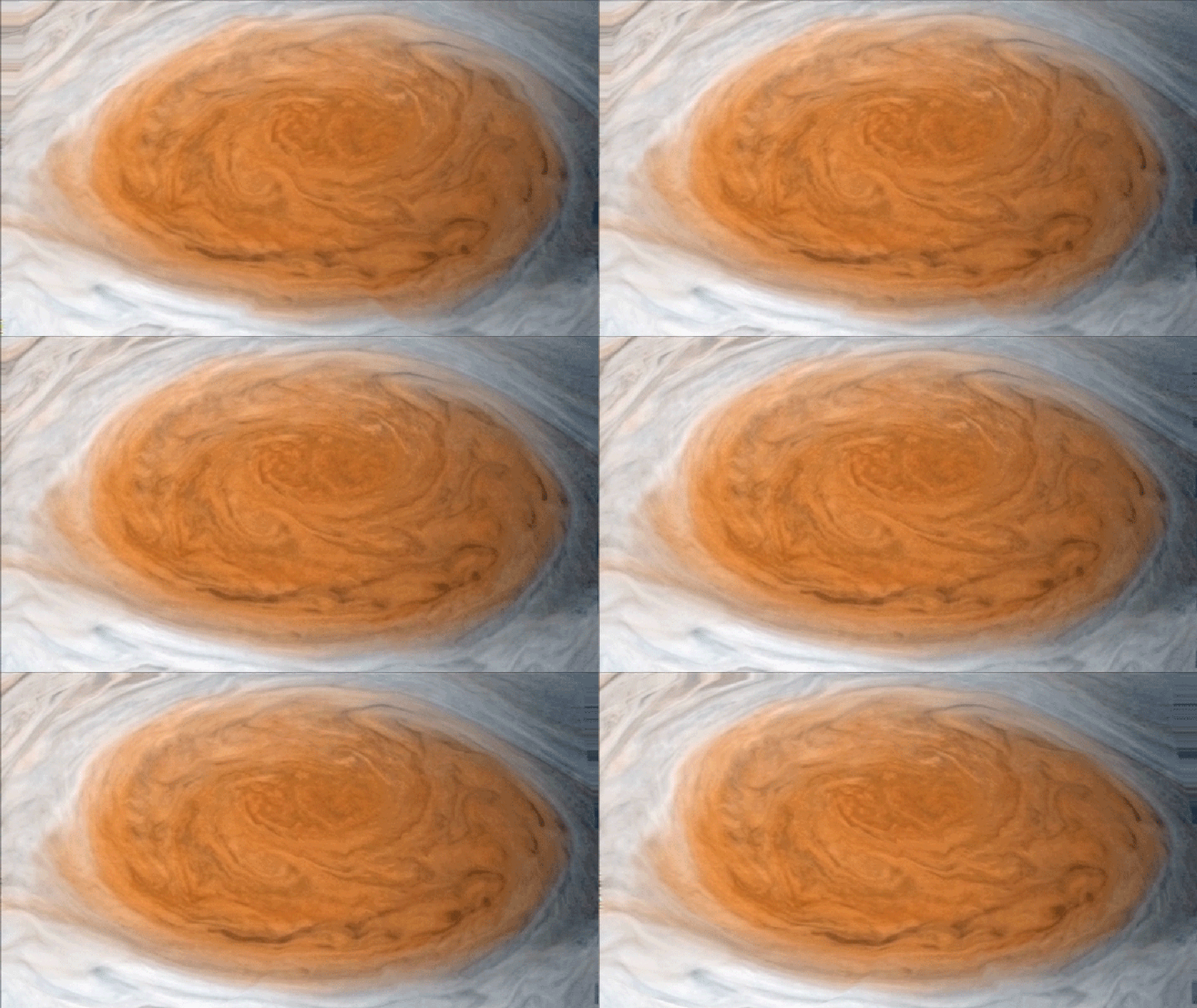
Winds around Jupiter's Great Red Spot are simulated in a JunoCam view that has been animated using a model of the winds there
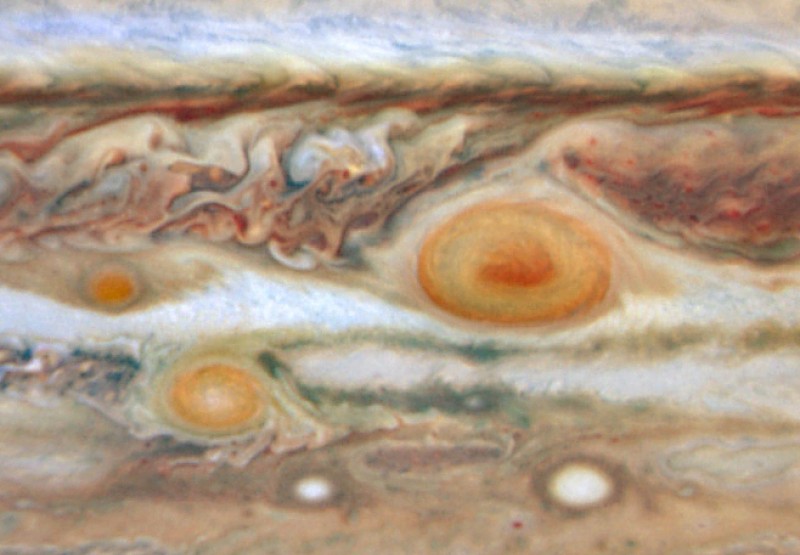
On 2008 May, Jupiter has a third red spot produced from a smaller whitish storm. All three are seen in this image made from data recorded on May 9 and 10 with the Hubble Space Telescope's Wide Field and Planetary Camera 2. Jupiter's recent outbreak of red spots is likely related to large scale climate change as the gas giant planet is getting warmer near the equator.
For scale, the Great Red Spot has almost twice the diameter of planet Earth, and both new spots shown above less than one Earth-diameter across.
1NASA, JPL-Caltech, SwRI, MSSS, Gerald Eichstadt and Justin Cowart.
2NASA, ESA, M. Wong, I. de Pater (UC Berkeley), et al.
https://apod.nasa.gov/apod/ap080523.html
3Prandtl-Essentials of Fluid Mechanics. Herbert Oertel Jr. (Herausgeber). 3rd ed. 2010. Springer-Verlag New York.