Kelvin-Helmholtz clouds form when pressure differences amplify disturbances at the interface between two air layers, lifting wave crests toward the faster flow and pressing troughs downward until they develop into characteristic billows. After wind is forced up and over a barrier such as a mountain, the air continues in a wavelike pattern through the atmosphere. Complex evaporation and condensation processes create the capped tops and cloudless troughs of these waves. These clouds occur when there is a difference in wind speed or direction between two atmospheric layers.
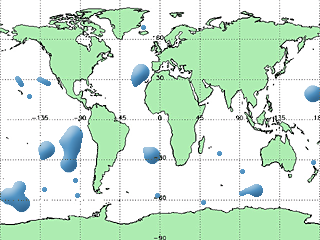
Although this instability is rarely observed in large air masses, it can occasionally be seen over the Southern Hemisphere in regions with strong extra-tropical cyclones, where greater space and higher wind speeds favor its development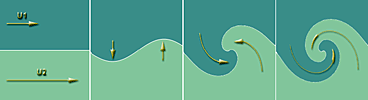
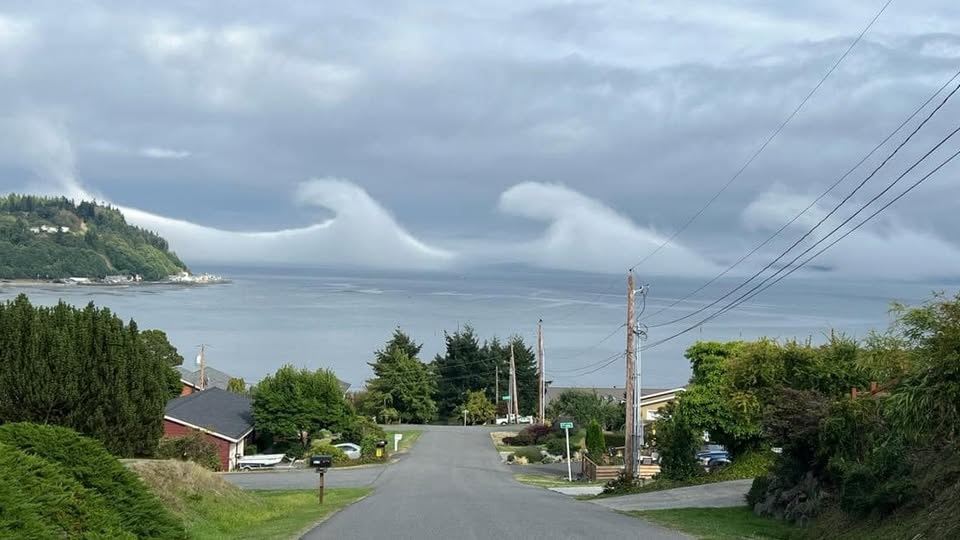
1Cathy O'Keefe. "Wave" clouds, or Kelvin-Helmholtz clouds, seen from Whidbey Island toward Possession Point on Sept. 3. 2024.
2M. Paperin. 'Kelvin-Helmholtz Instability' Cloud Structure (KHICS).
https://www.brockmann-consult.de/CloudStructures/kelvin-helmholtz-instability-description.htm