The dimensionless Mach number is defined as \[ \text{Ma} = \frac{V}{c} = \frac{\text{Speed of flow}}{\text{Speed of sound}} \] where $c$ is the speed of sound, whose value is 346 m/s in air at room temperature at sea level. A flow is called sonic when Ma = 1, subsonic when Ma < 1, supersonic when Ma > 1, and hypersonic when Ma ≫ 1.
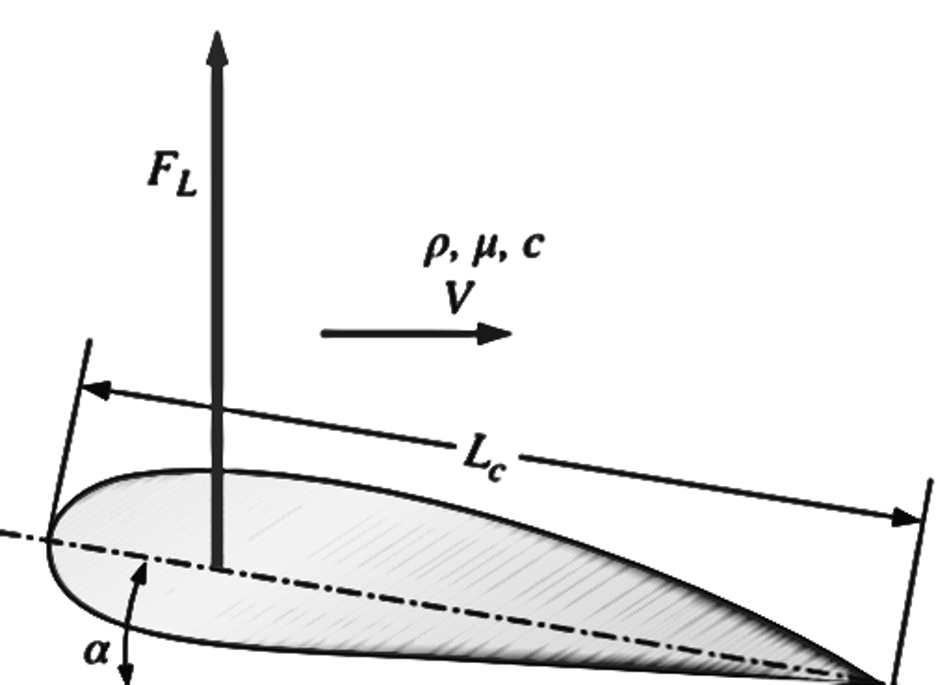
(1) Some aeronautical engineers are designing an airplane and wish to predict the lift produced by their new wing design.
The chord length \(L_c\) of the wing is 1.12 m, and its planform area \(A\) (area viewed from the top when the wing is at zero angle of attack) is 10.7 m².
The prototype is to fly at \(V = 52.0 \, \text{m/s}\) close to the ground where \(T = 25^\circ \text{C}\). They build a one-tenth scale model of the wing to test in a pressurized wind tunnel. The wind tunnel can be pressurized to a maximum of 5 atm. At what speed and pressure should they run the wind tunnel in order to achieve dynamic similarity?
Lift \(F_L\) on a wing of chord length \(L_c\) at angle of attack \(\alpha\) in a flow of free-stream speed \(V\) with density \(\rho\), viscosity \(\mu\), and speed of sound \(c\).
The angle of attack \(\alpha\) is measured relative to the free-stream flow direction.
1 This problem set contains 6 problems, and your final score will be based on Problem 1 and one additional problem on which you earned the highest score.