The Theory of Homogeneous Isotropic Turbulence
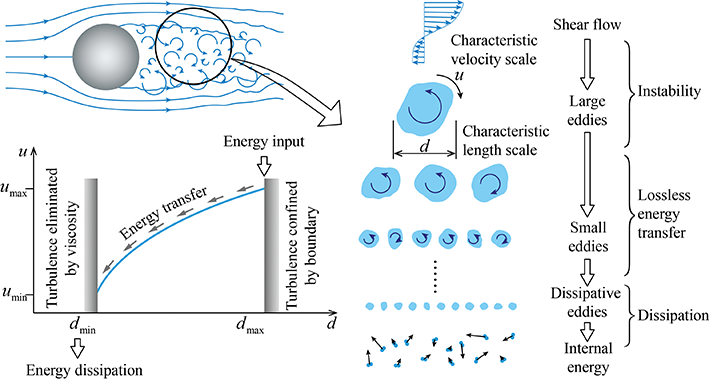
As the complex motion of a fluid, turbulence flow is difficult to describe with a general theory.
So far, a theory has been established for homogeneous isotropic turbulence.
Andrey Nikolaevich Kolmogorov (1903-1987), a scientist from the former Soviet Union, made the greatest contributions to this theory
On the basis of previous turbulence theories, in 1941 Kolmogorov proposed a model describing a
universal structure of small-scale turbulent motion within a homogeneous fluid under high Reynolds numbers,
which is sometimes called the K41 theory
The aim of turbulence theory is to investigate the transportation of energy through the formation,
interaction, and dissipation of eddies.
The so-called energy refers to the turbulent kinetic energy,
which is related to the fluctuating velocity components. For homogeneous isotropic turbulence, the averaged fluctuating velocity components in all directions remain the same, and the turbulence kinetic energy is expressed as
$$
k = \frac{1}{2} \left( \overline{u'^2} + \overline{v'^2} + \overline{w'^2} \right) = \frac{3}{2} \overline{u'^2}
$$
1Hongwei Wang (2023). A Guide to Fluid Mechanics. National Defense Industry Press.
2"I came to the USSR with the specific purpose of finding out whether Andrei Nikolaevich Kolmogorov is an individual or an institution" — J Wolfowitz