Boussinesq's Turbulent Viscosity Hypothesis
To construct a turbulent viscosity model, the eddy-viscosity coefficient $\nu_t$ should be represented approximately by
scale variables of the turbulence. Turbulence is multi-scale
A turbulent flow contains at least three typical scales
the scale of the mean flow
the scale of the energy-containing eddies in the inertial range
the scale of the dissipative eddies (also called the Kolmogorov scale).
For fully developed turbulence far from solid walls,
it is reasonable to assume that the characteristics of the turbulent motion depend mainly
on the length scale $\ell$ and time scale $\tau$ of the energy-containing eddies in the inertial range.
Through dimensional analysis
$$
\nu_t \propto l^{2}\tau^{-1},\qquad
k \propto l^{2}\tau^{-2},\qquad
\varepsilon \propto l^{2}\tau^{-3},\qquad
\frac{\overline{\omega_i\omega_i}}{2}\propto \tau^{-2},\qquad \cdots
$$
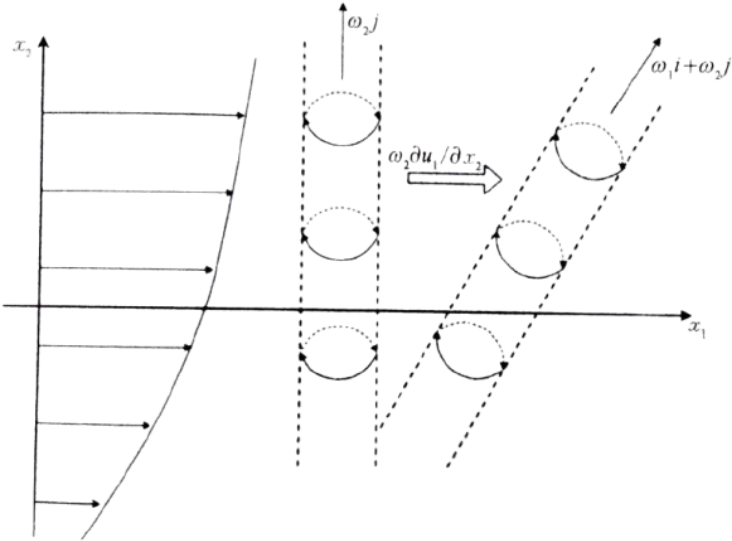
where $k$ is the turbulent kinetic energy per unit mass, $\varepsilon$ the dissipation rate of turbulent kinetic energy, and $\omega_i\omega_i/2$ the enstrophy
1Song Fu & Liang Wang (2023). Theory of Turbulence Modelling. ISBN 978-7-03-074639-9.
2The half of the mean square of the fluctuating vorticity per unit mass is defined as the enstrophy, denoted $e=\overline{\omega_i\omega_i}/2$.The importance of enstrophy is its relation to the dissipation rate of turbulent kinetic energy.