The Theory of Homogeneous Isotropic Turbulence
The smallest eddy in a turbulent flow is called a dissipative eddy,
with a Reynolds number of 1. Its size is called dissipative scale, or Kolmogorov scale $\eta$.
On this smallest scale, turbulent kinetic energy will be rapidly dissipated by viscosity.
The Reynolds number based on the dissipative eddy is expressed as
$$
Re_k = \frac{u_k \eta}{\nu} \sim 1
$$
where $\nu = \mu / \rho$ is the kinematic viscosity of the fluid and $u_k$ may be simply understood as the rotational velocity of the dissipative eddy
This formula apparently states that the higher the viscosity, the larger the dissipative eddy size. However, this is not the case, because $u_k$ is also related to the viscosity
The dissipation rate of turbulent kinetic energy, denoted by $\varepsilon$, is the rate at which the turbulent kinetic energy is converted into internal energy. The following relation can be obtained
$$
\eta \sim \left( \frac{\nu^{3}}{\varepsilon} \right)^{1/4}
$$
For a fluid, the greater the turbulent kinetic energy taken from the mean flow, the smaller the dissipation eddy size
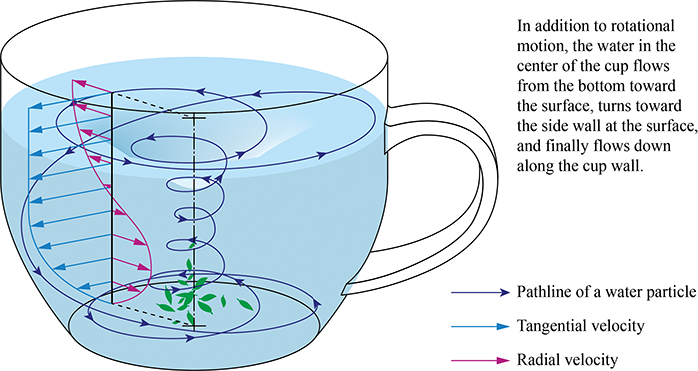
Suppose you are stirring a glass of water. The faster you stir, the more chaotic the water becomes - that is, the fluid eddies cover a wider range of spatial scales. More intense stirring results in a greater production rate of turbulent kinetic energy, and the wider range of spatial scales imply a smaller size of the smallest eddy (dissipative eddy)
 ◀
▶
◀
▶