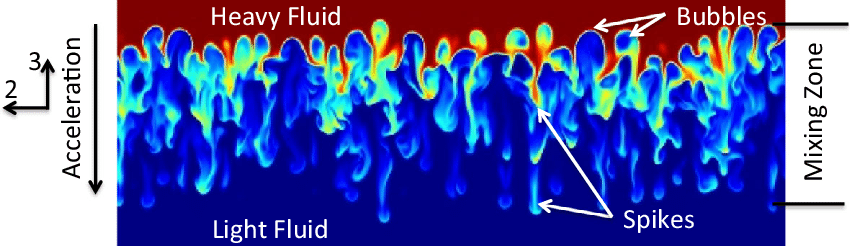
Rayleigh-Taylor instability is an interfacial hydrodynamic instability that develops when two fluids of different densities, separated by an interface and subjected to a relative acceleration. It occurs widely in unstably stratified natural, industrial, and astrophysical systems, including coastal upwelling near the ocean surface, atmospheric and cloud dynamics, plasma physics phenomena, the ignition of supernovae, air bubble formation in divers' bloodstreams, and premixed combustion processes.
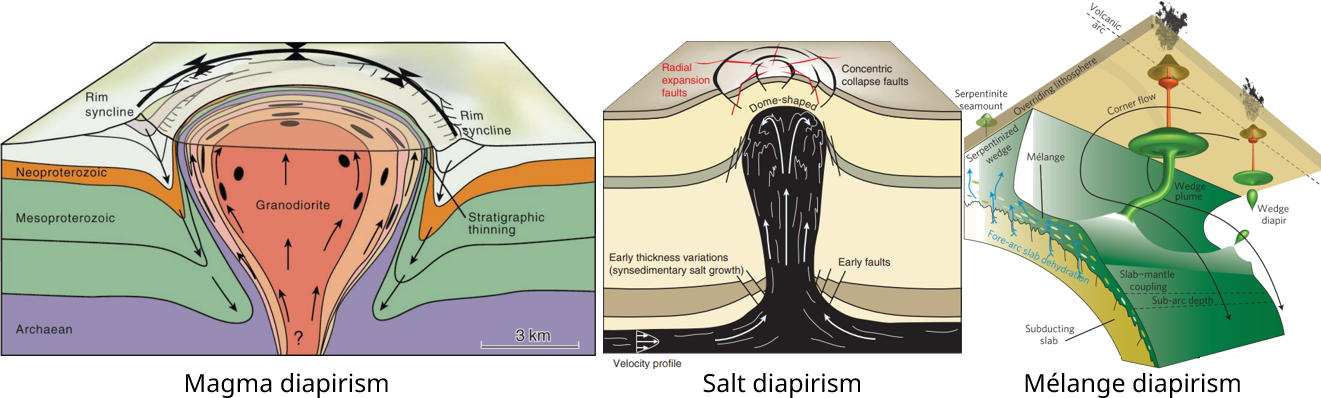
Many geological phenomena can be explained by this principle, such as diapirism. Magma can form diapirs, salt can form diapirs, deep crustal rock mixtures can form diapirs, and even ultrahigh-pressure solid rocks from depths of about 100 km can rise to the surface through diapirism. All of these processes are driven by buoyancy forces resulting from density differences.
1 Schwarzkopf, J. & Livescu, Daniel & Baltzer, Jon & Gore, R. & Ristorcelli, J.. (2015). A Two-length Scale Turbulence Model for Single-phase Multi-fluid Mixing. Flow, Turbulence and Combustion.
2 Rahman, S. M., & San, O. (2019). A Relaxation Filtering Approach for Two-Dimensional Rayleigh-Taylor Instability-Induced Flows. Fluids, 4(2), 78.
3 H. Fossen, Structural Geology, 2nd ed. Cambridge: Cambridge University Press, 2016.
4 Marschall, H., Schumacher, J. Arc magmas sourced from mélange diapirs in subduction zones. Nature Geosci 5, 862-867 (2012).